The Wonder of Wonder at Whip-poor-will Hill
October 21, 2026Just past Fife Lake, a gravel road winds past a long, unbroken stretch of state forest land, following a tree canopy that narrows as it draws closer to Whip-poor-will Hill. The Eberhardt cabin is easy to miss if you’re not watching for it. Situated on a hillside, it’s a rustic home tucked into a vast, forested landscape of private, protected land that feels like a park system of its own.
Inside, Laurie Eberhardt and her family—husband Peter Martin and children Ellie and Sylvie—can be found throughout the year, enjoying the view from a large front window that overlooks the land their family has known for more than 65 years. The room is part of the original structure that Laurie’s parents, Arthur and Marion, started building the year she was born.
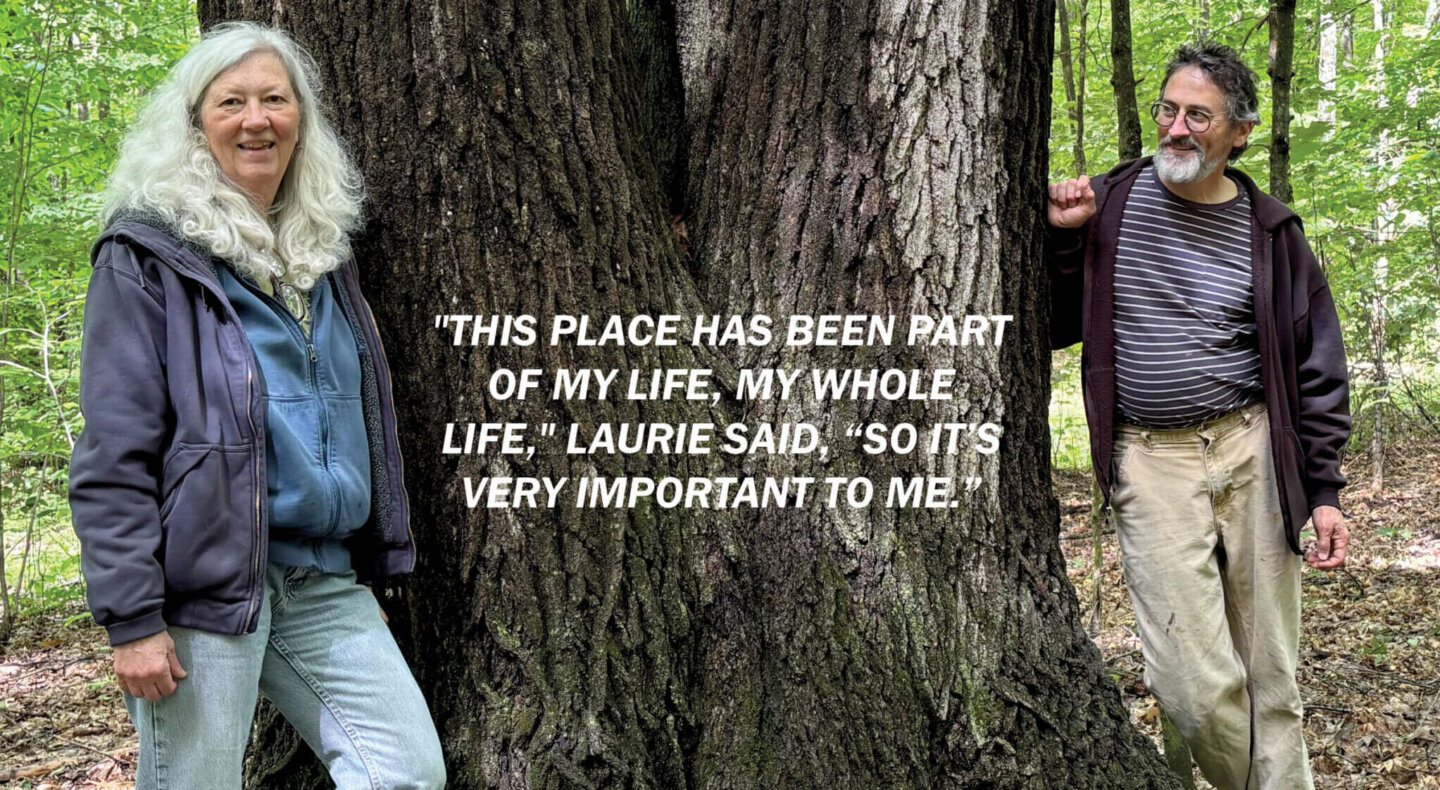
“This place has been part of my life, my whole life,” Laurie said, “so it’s very important to me.”
In 1959, a few years before building the cabin, Art and Marion bought the first 80 acres of what would become their 150-acre property in Kalkaska County. The cabin itself came together in stages, too, built by hand—without power tools—using windows and hardware collected from garage sales. Laurie’s older siblings, both adolescents at the time, helped where they could.
A passion for education ran through both sides of the family, as did an unmistakable love for the natural world. Art taught for nearly 40 years at what is now Trine University in Angola, Indiana, while Marion, a Lansing native, was teaching in Petoskey when the two first met.
Art read Thoreau, Emerson and Sigurd Olson, and spearheaded one of the first Earth Day celebrations at his university in 1970, where an environmental center now bears his name. For decades, he organized an annual tree-planting festival at a nearby nature preserve and helped local forests through his board service with ACRES Land Trust. A wooded parcel in Angola is named Marion’s Woods, in honor of his wife, thanks to his advocacy.
Marion, for her part, ran a small nature-craft business, led Girl Scouts and Brownies, and was, in Laurie’s memory, always ready to pack a bag and head for the woods.
When they bought the Kalkaska property, it was largely open canopy woodlands, home to Whip-poor-wills, Bluebirds, Tree Swallows, smooth green snakes and other oak savanna species.
Laurie recounted her father capturing birdsongs and sounds of nature using a reel-to-reel tape recorder, and as a family, collecting seedlings from the state park and along roadsides, growing them at home before planting them across their new property. “I remember flats of seeds and vermiculite in the refrigerator when I was growing up,” Laurie laughed. “You opened the fridge, and it was all seeds!”
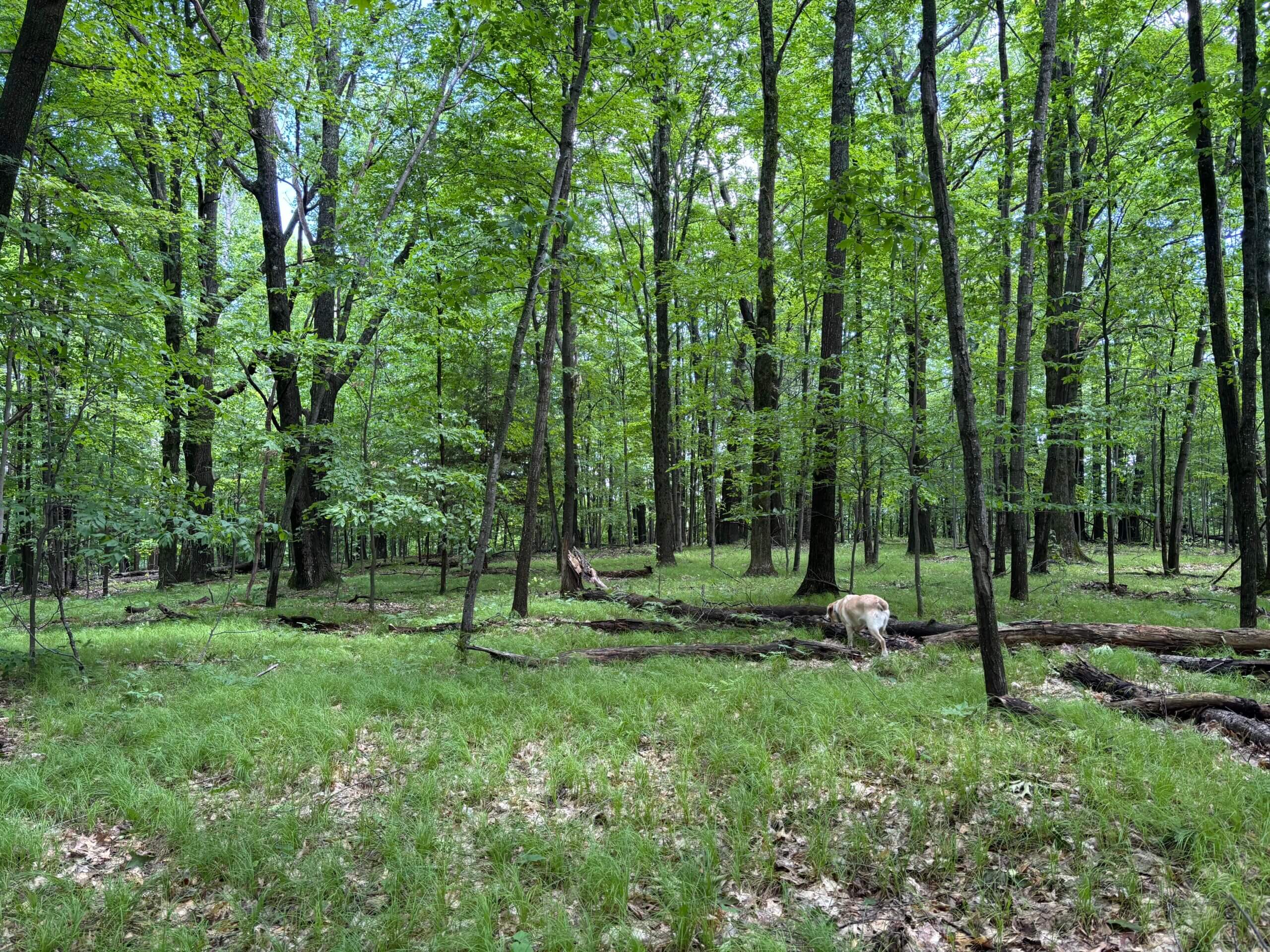
Over the following decades, the Eberhardts planted well over a thousand trees on the property, transforming the open land they’d purchased into the thriving, mature forest that stands there today. “Now there are Red-eyed Vireos, Scarlet Tanagers and things that weren’t there then,” Laurie said, describing the land’s natural progression, “so it’s really just shifted.”
In 2007, when an estate tax change prompted the Eberhardts to seriously consider the land’s future, Art was already familiar with the concept of a conservation easement through his work with ACRES Land Trust. Beyond the tax incentive, what mattered most, Laurie said, was “keeping the land in one big piece and not developed.”
She recalled the day a land protection specialist with the Conservancy walked the property with her father. “He was so appreciative and so excited about protecting the land,” Laurie said. “That really, clearly helped my dad feel like ‘This is right, and somebody appreciates what I like.’”
In December that year, her parents donated the value of a conservation easement on the property to GTRLC, permanently protecting its forests, wetlands and the natural springs that feed a tributary of the Manistee River.
While Art passed in 2020, and Marion a decade earlier, the easement they signed is still at work nearly 20 years later, now perhaps more than ever. Laurie and Peter regularly field calls and letters from buyers, including gas companies interested in drilling. “We probably get a couple of solicitations a week to buy this place,” Laurie said. “It’s very easy to answer those: ‘No, this land is protected. [It] has a conservation easement.”
Laurie credits her parents’ reverence for the land and nature as having influenced her own professional calling. A professor of biology at Valparaiso University in Indiana, she has spent much of her career studying the relationships between plants and animals, from the behavior of birds around the plants they depend on to how microplastic pollution now shapes the behavior of aquatic organisms.
“That kind of land ethic—that Aldo Leopold land ethic ran through the family for sure,” she explained.
Referring to a small stream that her family named Eberhardt Creek, which starts in the property’s swamp and feeds into the Manistee River, she said, “I always felt we’re part of that, helping the Manistee stay clean.” She also thinks about the carbon that the maturing forest has absorbed over the decades. “It’s our little carbon bank here.”
That same passion for studying the natural world has carried into the next generation. Sylvie recently completed a dissertation studying pitcher plants at GTRLC’s Upper Manistee Headwaters: The Milock Family Preserve, not far from the family cabin.
“We used a wheelbarrow to carry all our stuff,” Laurie said, describing a day she joined Sylvie in the field. The opportunity to help with their research, in a protected bog—decades after her parents protected their family’s land—felt like coming full circle. “We had a blast. It was very lovely for me to have that.”
Today, the cabin remains a constant in the family’s lives. A favorite New Year’s tradition is lighting lanterns and sledding down the old two-track behind the cabin. Summer days are spent paddling the Manistee, followed by games around the table and pizza from a clay oven the family built themselves.
There aren’t trails at Whip-poor-will Hill—an intentional choice Art and Marion made that the family has kept. “I think that is part of the love of the land—not designing things to get to your destination quickly, but to appreciate where you are and wandering about,” Laurie reflected. “That was an important family value. The journey is the important part.”
Peter, who also spent his career teaching, recalled his first few visits to the cabin. Laurie had oriented him to the hill and used landmarks to explore the land, like the oak tree that still marks the way to the swamp. “There was no need or desire to go the same way twice,” he said. “It wasn’t because you took that path to get there, because there was no path.”
Laurie added, “It was just sort of the wonder of wonder…and this was a place to immerse ourselves in that.”
Categorised in: Stories of Support